
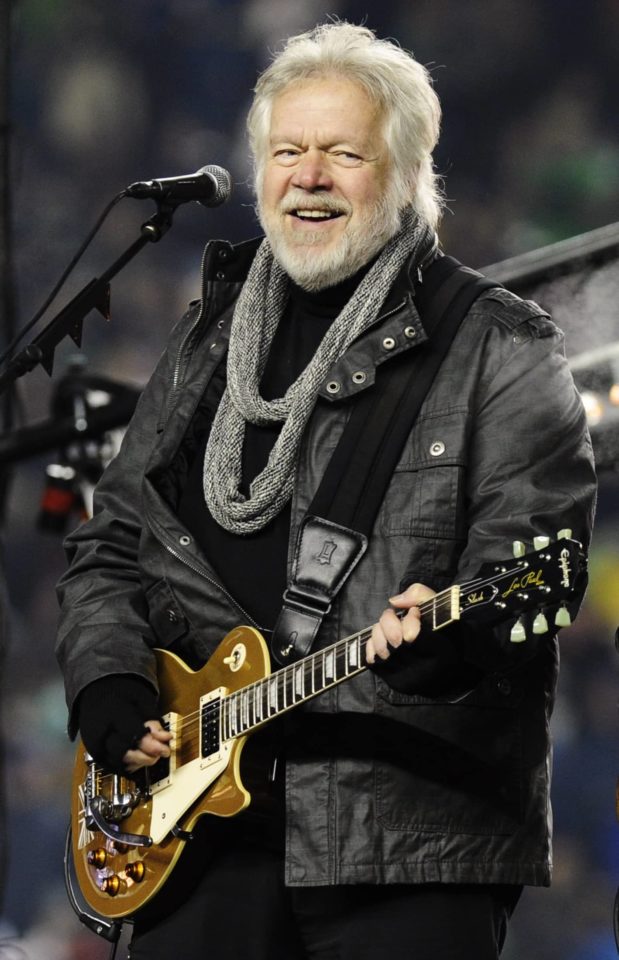
The Bachman-Turner Overdrive song “Takin’ Care of Business” in a roundabout way was inspired by The Beatles’ “Paperback Writer.” BTO’s Randy Bachman says that one way he liked to inspire himself as a songwriter was to take a song that was popular at the time and try to write a follow-up to it. Back in 1967, when he was still in The Guess Who, he did that with The Beatles’ “Paperback Writer.” He explains how even though his attempt at a song was unsuccessful, it produced the lyrics to one of his next group’s signature songs, “Takin’ Care of Business.” here is Randy Bachman on how a song he never finished for The Guess Who became the basis of BTO’s “Takin’ Care of Business.”
“When it got to the hook, it went ‘White Collar Worker,’ just like ‘Paperback.’ And I played it for Burton Cummings, who gagged and said, ‘Wow, Rand. We’re going to get sued by the best. Lennon and McCartney are going to sue us for that.’ And many years later, playing with BTO, when Fred Turner lost his voice, and I had to find out a song to sing onstage, I pulled out ‘White Collar Worker.’ I knew nobody liked that hook, ‘white collar worker.’ I’d heard a D-J the same day as I was driving to this gig, saying, ‘This is Darrel Bee on C-FUN radio. We’re taking care of business.’ There’s a great song title and onstage that night I threw away that chorus, put in a new chorus of ‘taking care of business.’ ‘Takin’ Care of Business’ was written on stage that night.”
“I sat down and wrote a song called ‘White Collar Worker.’ And I played it for The Guess Who and they kind of said, ‘Aah, it’s too much like ‘Paperback Writer’ and it’s got too many chords.’ But the words in the verses were, ‘You get up in the morning from the alarm clock’s warning, take the 8:15 to the city.’ Now, we had just seen commuting in New York and Chicago, where The Guess Who were recording – they didn’t have it in Winnipeg – but we saw guys getting on a train and commuting and that’s what I was writing about. Nobody liked that song back in the Guess Who era, but I kept those words and never again referred to the song as ‘White Collar Worker.’”
REUTERS PHOTO